

Training harder is not always the answer for HYROX athletes. In some cases, it is part of the problem.
If your easy runs gradually become tempo runs, your compromised running sessions turn into full race simulations and every group workout leaves you exhausted. You may be accumulating plenty of fatigue without developing each physiological component of fitness as effectively as you could.
The goal of training is not to be tired, it is to adequately stress your various physiological systems to drive adaptation. It is not how hard you can train in any one session, it is how much adaptation you can accumulate over days, weeks and months of training without burning out or getting injured.
The solution is not to avoid hard training. HYROX is a demanding event, and your program needs to prepare you for that reality. The issue is whether each session has a clear purpose.
Your HYROX heart-rate zones can help answer that question. But generic zones from a smartwatch or an age-based formula may not reflect your actual physiology closely enough to guide your training well.
Why HYROX Athletes Need More Than the Ability to Suffer
HYROX combines eight 1 km runs with eight functional stations: the SkiErg, sled push, sled pull, burpee broad jumps, rowing, farmer’s carry, sandbag lunges and wall balls.
That format creates an obvious training challenge. You need enough strength and muscular endurance to handle the stations, but you also need to keep running after each one.
The running component should not be treated as an afterthought.
In an early peer-reviewed study of HYROX performance, recreational athletes completed a simulated race in a median time of approximately 86 minutes. More than 51 minutes were spent running, compared with approximately 33 minutes completing the workout stations. Faster overall performance was associated with a higher VO₂max, greater endurance-training volume and faster running performance.
This was a small study, so it should not be treated as the final word on HYROX physiology. Competitive and elite athletes may have a different performance profile. Still, the practical message is reasonable: being strong enough to complete the stations is not the same as being well prepared to race.
Should Every HYROX Workout Feel Hard?

No.
Hard sessions matter, but making every session hard is usually a poor way to structure endurance training, and a good way to increase the risk of injury.
A common mistake is allowing too many workouts to drift into the middle: too difficult to recover from easily, but not sufficiently targeted to create the adaptations you wanted from a true threshold or high-intensity session.
Consider a typical training week: An athlete completes a hard HYROX class, a fast 8 km run, a compromised running workout (running after training stations) and a demanding lower-body lifting session. None of those sessions is unreasonable on its own. The problem is that the athlete may have unintentionally created four high-stress days while leaving very little room for high-quality aerobic volume to build their aerobic engine.
This is where training intensity distribution matters.
Research in endurance athletes generally supports a program that includes a substantial amount of genuinely low-intensity work alongside a smaller dose of harder training. Some studies favour a polarized approach, with most training completed at low intensity and a limited amount completed at high intensity. Other research suggests that a pyramidal approach can also work well, especially depending on the athlete’s training status and the phase of the program.
There is no single perfect ratio that applies to every HYROX athlete. HYROX is not a pure endurance sport, and your weekly plan must also account for lifting, muscular fatigue and station practice. But the broader principle is well established: every training session should not feel like a race.
If you are racing every workout, you are leaving gains on the table.
Why Generic Heart-Rate Zones Can Be Misleading
Heart-rate zones are ranges used to organize cardiovascular training intensity. They help distinguish an easy aerobic run from a moderate steady effort, a threshold workout or a higher-intensity interval session.
The problem is that many athletes rely on generic zones calculated from an estimate of maximum heart rate.
You may have seen formulas such as 220 minus your age. Some watches use more sophisticated algorithms, and wearables can be useful for monitoring trends. But even a reasonable estimate of your maximum heart rate does not tell you precisely where your individual physiological thresholds occur.
Two HYROX athletes can be the same age, have similar resting heart rates and train at the same gym, yet reach their first and second lactate thresholds at meaningfully different heart rates and running speeds.
A generic percentage cannot fully account for that difference. And if you do not know your specific thresholds, you could be leaving meaningful workout gains on table every time you hit the gym.
What Are LT1 and LT2?
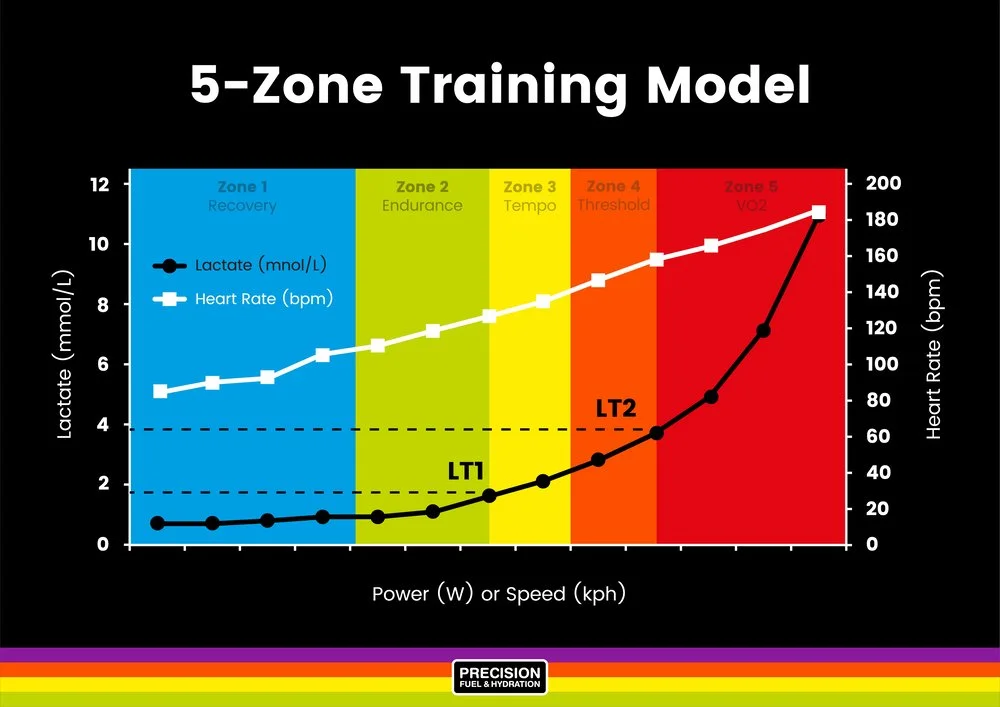
A graded VO₂max test can provide more than a single VO₂max score. When gas exchange is measured during progressively harder exercise, the test can help identify two useful transition points. These transition points are named your ventilatory thresholds, and they can then be used to estimate something much more useful: your lactate thresholds.
LT1: Your First Lactate Threshold
LT1 is the first lactate threshold. It broadly marks the transition from easier aerobic work toward a more demanding intensity.
Below LT1, you should generally be able to accumulate aerobic training volume with relatively manageable fatigue. This is often the most relevant anchor for easy runs and lower-intensity aerobic sessions. This is also where the Zone 2 methodology of easy training lives. It is enough stimulus to meaningfully increase your aerobic engine, but is easy enough on your muscles and connective tissue that you can accumulate a lot of volume at this training intensity.
LT2: Your Second Lactate Threshold
LT2 is the second lactate threshold, sometimes just called your anaerobic thresholds. It broadly marks the transition into a heavier exercise domain where maintaining the effort becomes increasingly difficult, and lactate levels start to accumulate exponentially.
LT2 can help guide tempo and threshold-oriented training. It also provides context for understanding how much sustainable high-end aerobic work you can tolerate before fatigue rises quickly.
These thresholds are not magical lines. Your physiology does not change completely because your heart rate increases by one beat per minute. Heat, hydration, sleep, stress and accumulated fatigue also affect the heart-rate response on a given day.
But individualized thresholds provide a more defensible starting point than relying entirely on generic heart-rate zones estimated by a watch on online calculator.
Does Zone 2 Training Matter for HYROX?
Yes, but it should not become another oversimplified rule.
Lower-intensity aerobic training helps athletes accumulate volume while limiting excessive fatigue. For HYROX athletes, that matters because the running sessions must coexist with sled work, lunges, wall balls, strength training and race-specific sessions.
The term “Zone 2” is also used inconsistently. On one watch, Zone 2 may be a percentage of estimated maximum heart rate. In a physiology lab, the intended intensity may be anchored more closely to LT1. Those are not necessarily the same thing.
If every run becomes moderately hard as you are consistently above Zone 2 (LT1), you may struggle to build enough weekly running volume without interfering with the rest of your program. Muscle fatigue quickly builds, tendons become overloaded, and injuries start to pop up more and more frequently as you try and ramp intensity closer to the competition.
The practical question is not whether Zone 2 is good or bad. It is whether your easy training is actually easy enough to serve its intended purpose.
What a Smarter HYROX Week Looks Like
A better training week separates different goals rather than blending everything together.
Some sessions should build aerobic volume and feel controlled. Some should improve your ability to sustain a demanding pace. Some should develop VO₂max. Other sessions should practise running after stations, improve sled proficiency or build muscular endurance.
Race simulations can be useful, especially as an event approaches. But constantly testing yourself is not the same as training productively.
For example, an athlete who fades badly during the final three runs may assume that the answer is more compromised running. That may be correct. But the underlying issue could also be insufficient aerobic capacity, a poorly developed threshold, excessive early pacing, inadequate strength endurance or a weekly program with too much accumulated fatigue.
A generic plan cannot reliably tell you which limitation matters most.
What Performance Testing Can and Cannot Tell You
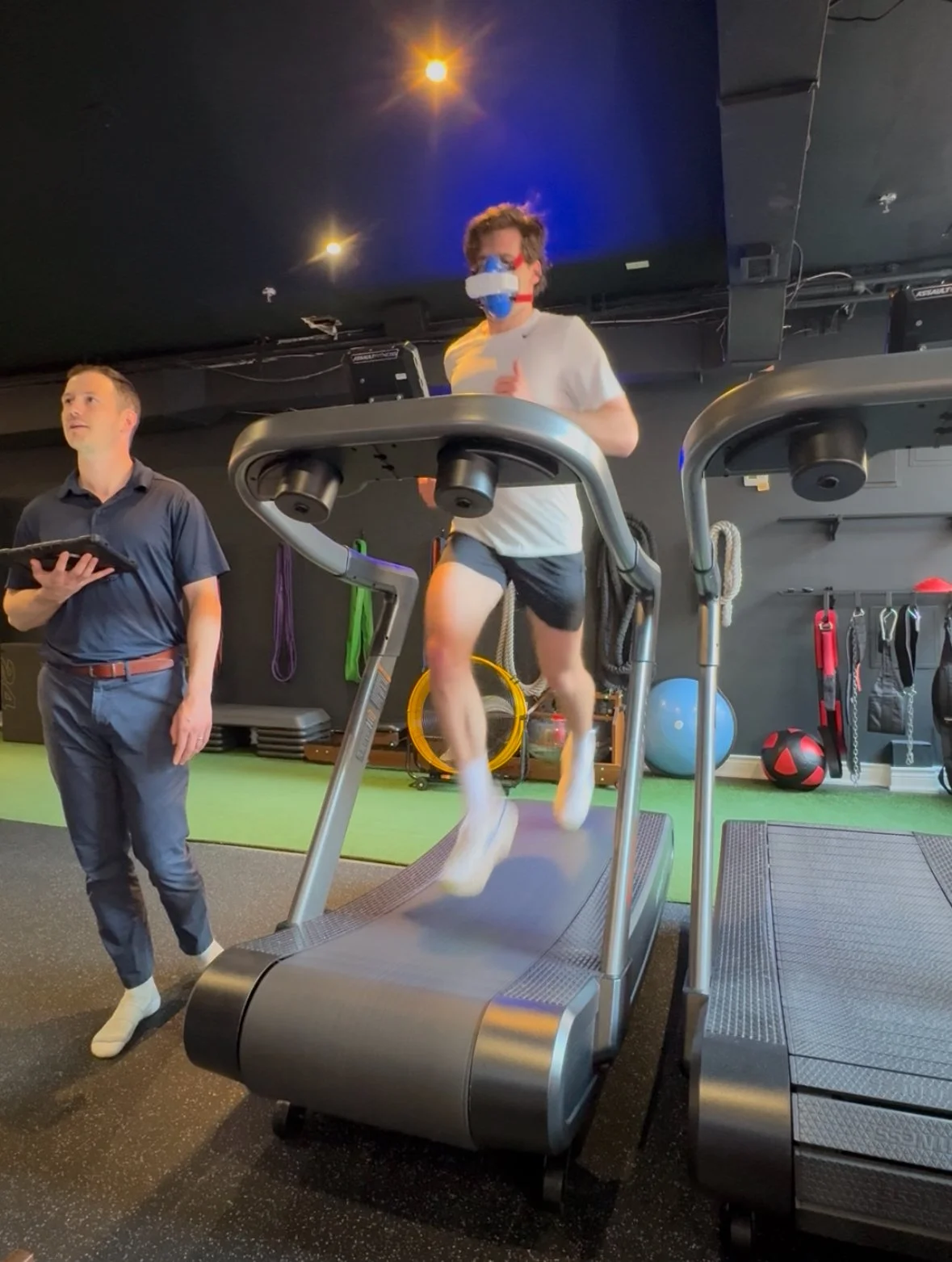
A VO₂max test cannot predict your exact HYROX finishing time. It cannot tell you how efficiently you will push a sled, whether your wall-ball technique will break down or how well you will pace the first kilometre in a competitive environment.
It can give you a clearer physiological baseline and a solid foundation to build a personalized training program around.
A well-interpreted test can help identify your VO₂max, your ventilatory and/ or thresholds and more individualized heart-rate and pace ranges. Those results can make your easy sessions more deliberate, your quality sessions more targeted and your training decisions less dependent on guesswork.
For competitive HYROX athletes in Toronto, that can be especially useful before starting a focused training block, after a plateau or when training consistently without seeing the expected improvement.
Training hard is part of the sport. Training hard every day is not the same thing as training well.
To establish more individualized training zones and clarify what to prioritize in your next block, learn more about performance testing or book a VO₂max assessment.
Frequently Asked Questions
Are smartwatch heart-rate zones accurate enough for HYROX training?
Smartwatch zones are a reasonable starting point, especially for recreational training. However, they are often based on predicted or estimated values. A graded exercise test can provide a more individualized assessment of your ventilatory thresholds and training ranges.
How much Zone 2 training should a HYROX athlete do?
There is no universal percentage that applies to every athlete. Your ideal balance depends on your running background, strength training, race schedule, recovery and current limiting factors. Most athletes benefit from including genuinely easy aerobic work rather than making every run moderately hard.
Is VO₂max the most important factor for HYROX performance?
VO₂max appears to matter, but it is not the only factor. VO₂max sets the ceiling of your aerobic engine, but HYROX performance also depends on sustainable running pace, muscular endurance, station efficiency, pacing and the ability to run under fatigue.
Can a VO₂max test predict my HYROX race time?
Not precisely. A VO₂max test provides useful physiological information, but it does not capture every factor that affects race performance. It is better used to guide training decisions than to promise an exact finishing time. It is going to be hard to have a competitive HYROX time without a high VO₂max, but having a high VO₂max does no guarantee success.