
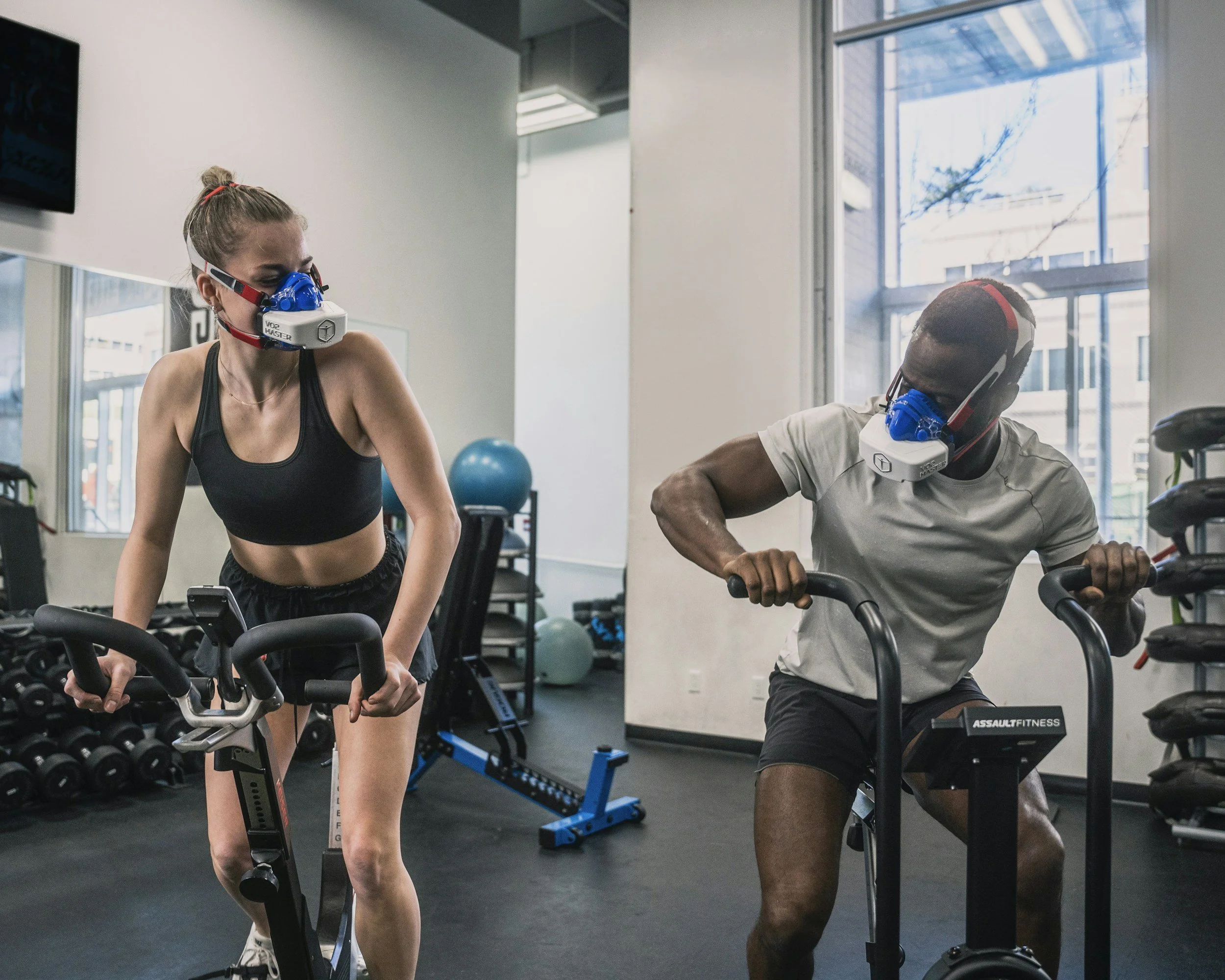
VO₂max Testing in Toronto
Measure your aerobic fitness, understand your heart rate zones, and make your training more specific.
VO₂max testing gives you objective information about how your body uses oxygen during progressively harder exercise. Instead of guessing your fitness level from a watch estimate or using generic heart rate formulas, a VO₂max test gives you more specific data that can be used to guide endurance training, pacing, and long-term fitness goals.
At my downtown Toronto clinic, VO₂max testing is designed for runners, HYROX athletes, endurance athletes, and active adults who want a clearer picture of their cardiovascular fitness and how to train more effectively.
VO₂max testing at a glance
Location: Thrive Longevity Training, 518 Yonge Street, Toronto, ON M4Y 1X9
Price: $175.00 CAD
Appointment length: 45 minutes
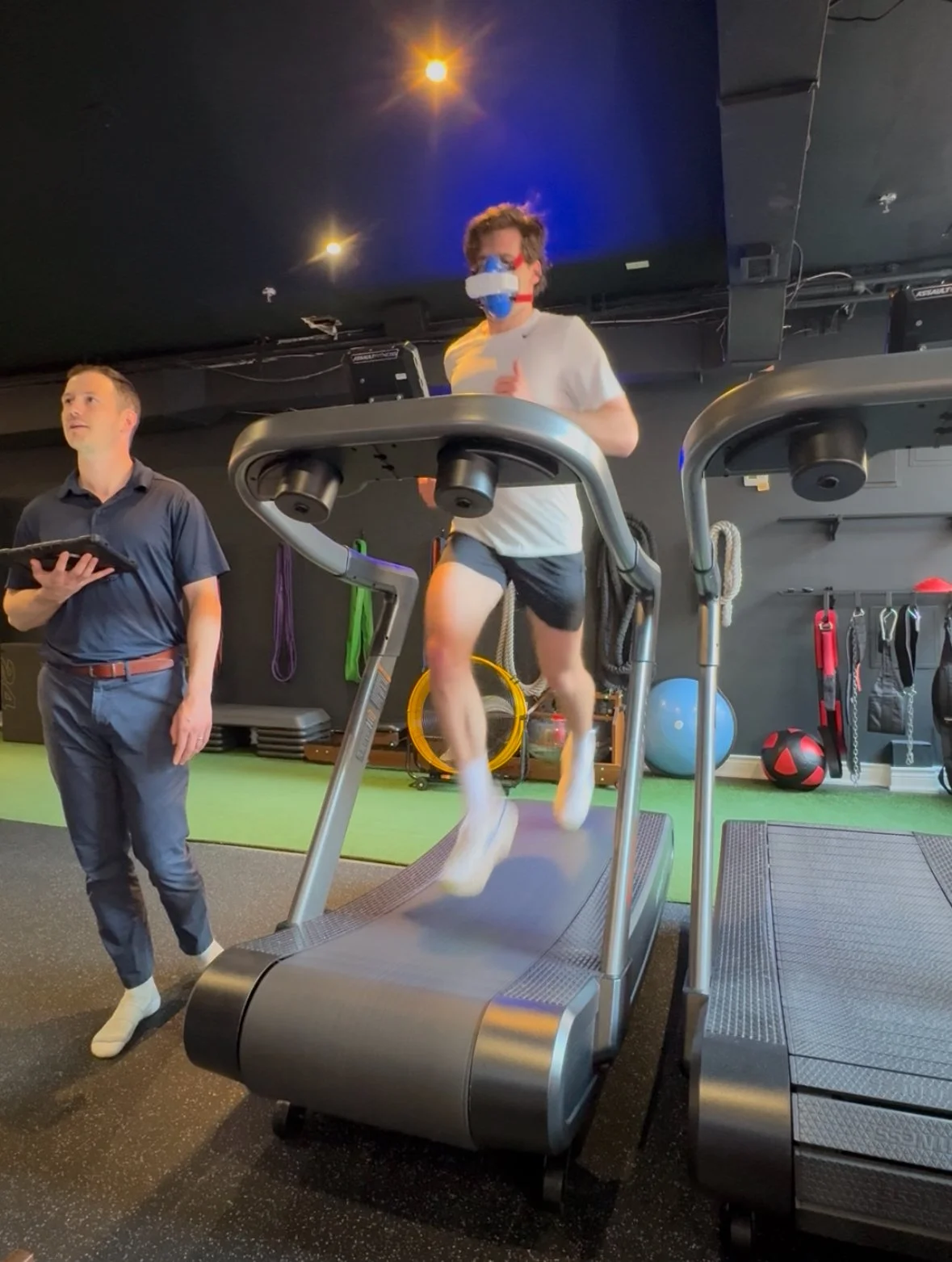
Testing modality: Treadmill (regular or curve) or Air Bike
Equipment: VO2master Analyzer, Polar Verity Sense Arm Band HR sensor
Test format: Individualized graded exercise test progressing toward maximal effort.
Included: VO₂max measurement, individualized training zones, threshold analysis, written report and results consultation.
Booking: Can book online at www.backinbalanceclinic.com or via phone at (416) 660-9932.
Note: Public VO₂max testing is available at 518 Yonge Street, near Yonge and Wellesley. You do not need to be a Thrive member or an existing chiropractic patient of Back in Balance Clinic to book.
What is a VO₂max test?
VO₂max is a measure of the maximum amount of oxygen your body can use during intense exercise. It is one of the most useful markers of cardiorespiratory fitness, but the number itself is only part of the picture.
A proper VO₂max test can also help identify how your body responds as exercise intensity increases. This can give you more useful training information than a single fitness score, especially if you are trying to improve running performance, prepare for an event, or train with more accurate heart rate zones.
Many watches estimate VO₂max using heart rate and pace data. Those estimates can be useful for tracking trends, but they are still estimates. A direct test gives you measured physiological data and allows the results to be interpreted in the context of your training, goals, and current fitness level.
If you want to learn more about VO₂max, performance testing, and other exercise and performance topics, you can check out the resources section!
Who is VO₂max testing for?
VO₂max testing is useful for people who want more objective information than pace, distance, or wearable estimates alone can provide.
This test may be a good fit if you are:
Training for a running race and want more accurate training zones.
Preparing for HYROX, triathlon, cycling, or another endurance-based event.
Trying to improve your aerobic base, threshold, or overall conditioning.
Unsure whether your easy runs are actually easy.
Returning to structured training after time away.
Interested in long-term cardiovascular fitness and healthy aging.
Trying to understand whether your current training is producing meaningful adaptation.
You do not need to be an elite athlete to benefit from testing. The goal is not just to find your highest possible number. The goal is to understand what your physiology says about your current fitness and how that should influence your training.

What do you learn from a VO₂max test?
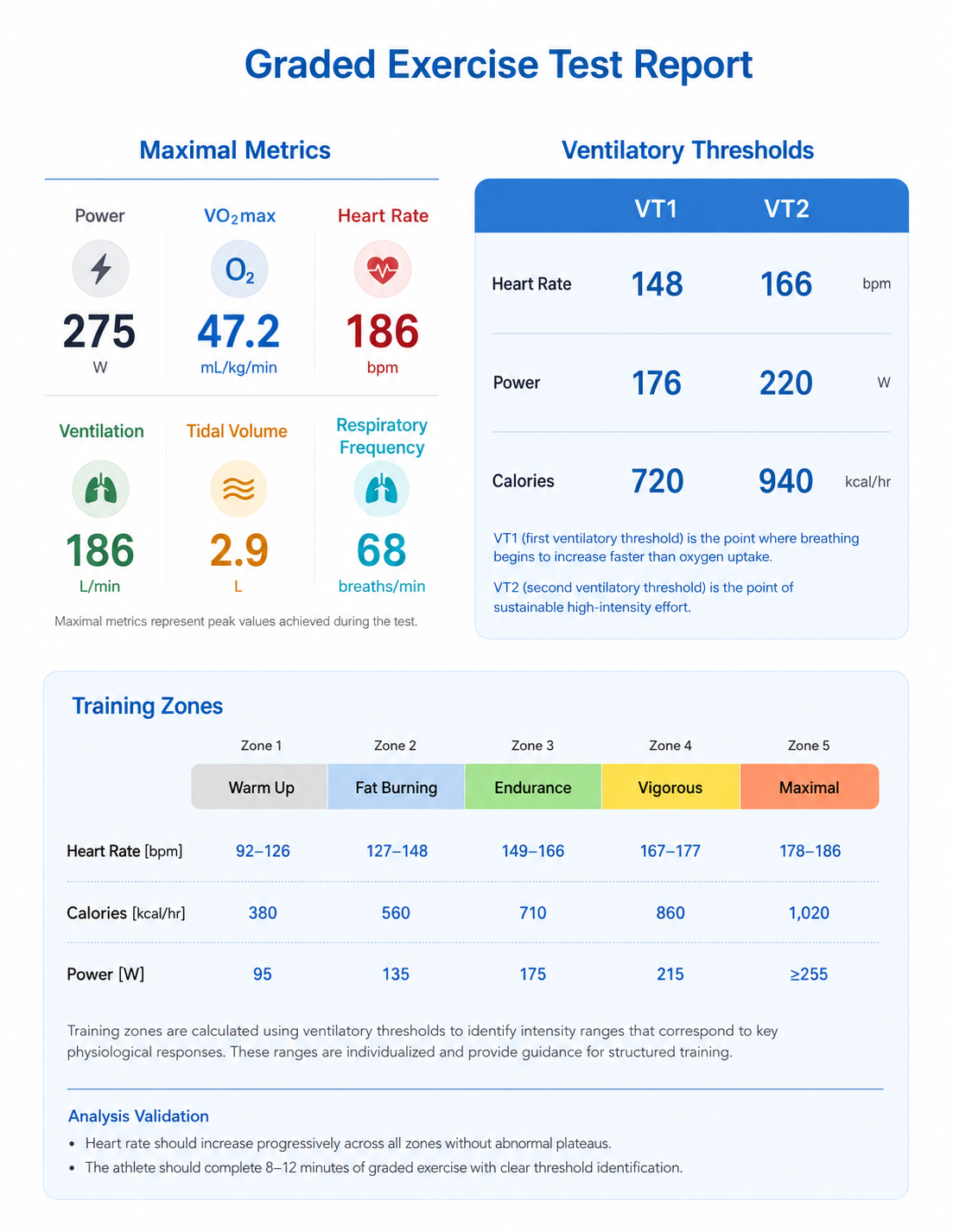
A VO₂max test gives you more than a fitness score. The most useful part is how the result changes your training decisions.
Depending on the testing protocol and your goals, your results may include:
Your measured VO₂max.
Your heart rate response to increasing exercise intensity.
Practical heart rate training zones.
A clearer understanding of your aerobic fitness.
Information that can help guide easy training, threshold work, and higher-intensity sessions.
A baseline that can be retested after a focused training block.
The goal is to leave with information you can actually use. A test result is only valuable if it helps answer practical questions: How hard should easy training feel? Where should most of your weekly volume sit? Are you training too hard too often? Is your cardiovascular fitness limiting your performance, or is something else more likely holding you back?
If you want to read more about how to use heart rate zones in your training for your next Hyrox race, check out our resources section: Read about heart rate zones for HYROX.
VO2max testing protocol
Brief review of health history, current training, injury history and testing goals.
Equipment fitting, calibration and resting measurements (heart rate, breathing rate, oxygen consumption)
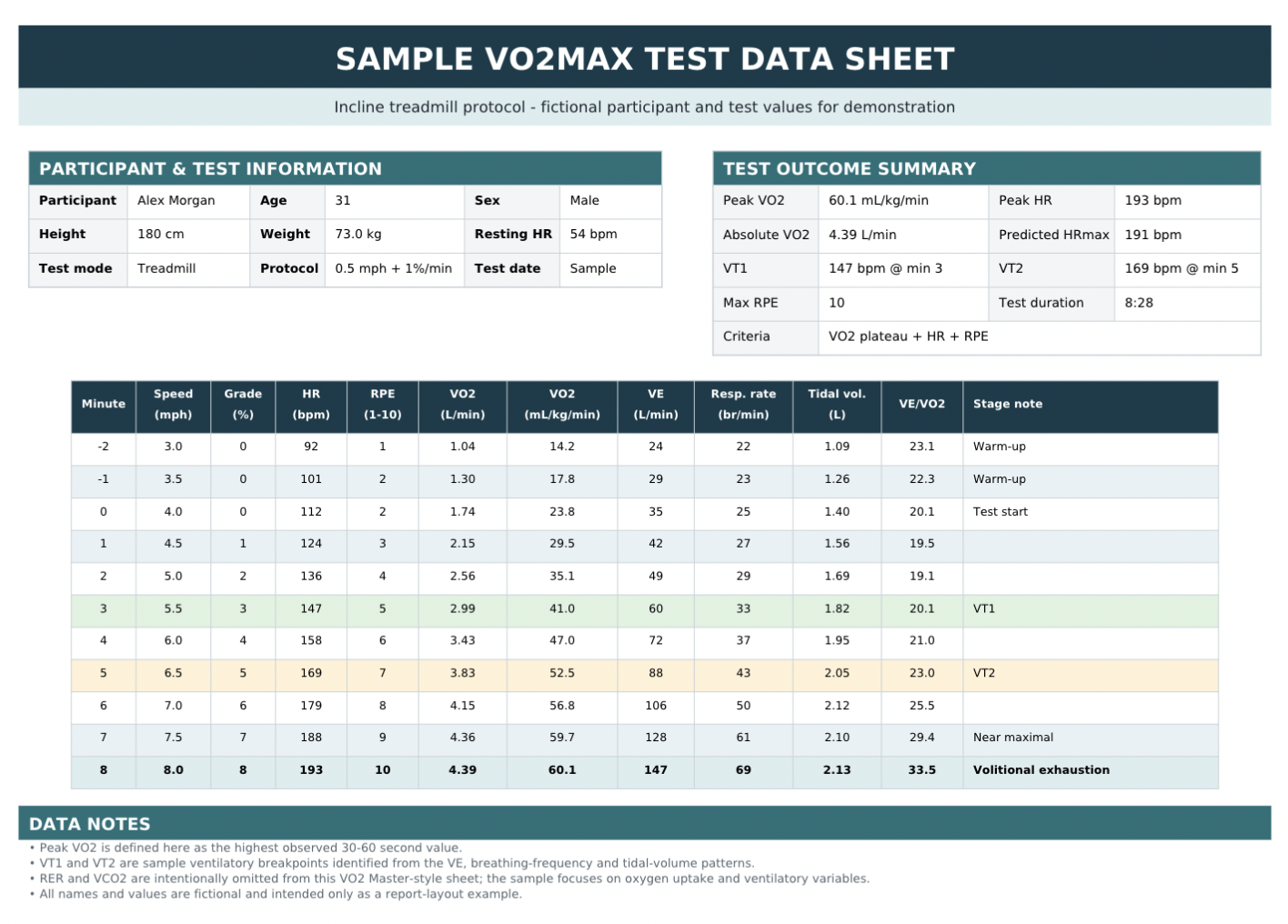
5-minute warm-up on the treadmill or bike.
Progressive increases in speed, incline or resistance until the test endpoint.
The starting work rate will be determined based on fitness and training history
Every minute, there will be a 0.5mph increase in speed, and a 1% increase in incline grade.
You will exercise to volitional exhaustion, with the test lasting between 8-12 minutes.
Measurements during the test will include heart rate, breathing rate, oxygen consumption, max heart rate, and ventilatory thresholds.
Recovery, data interpretation and review of the written report.

VO₂max testing for runners
For runners, VO₂max testing can help connect your physiology to your training plan.
Many runners train based on pace, but pace changes with terrain, heat, fatigue, stress, sleep, and training load. Heart rate is not perfect either, but when it is interpreted properly, it can help you understand how hard your body is working at a given pace.
VO₂max testing can be especially useful if you are:
Training for a 5 km, 10 km, half marathon, or marathon.
Trying to improve your aerobic base.
Unsure how hard your easy runs should be.
Doing too much moderate-intensity training without enough true easy work.
Returning from injury and rebuilding fitness.
Trying to understand whether your running limitation is more cardiovascular, mechanical, or load-related.
For many runners, the value of the test is not simply knowing whether their VO₂max is “good.” The value is using the data to make better training decisions.
Beyond just VO₂max testing, we offer a variety of other services for runners including biomechanical running gait analysis, injury management and rehabilitation, and functional movement analysis with associated strength program planning.
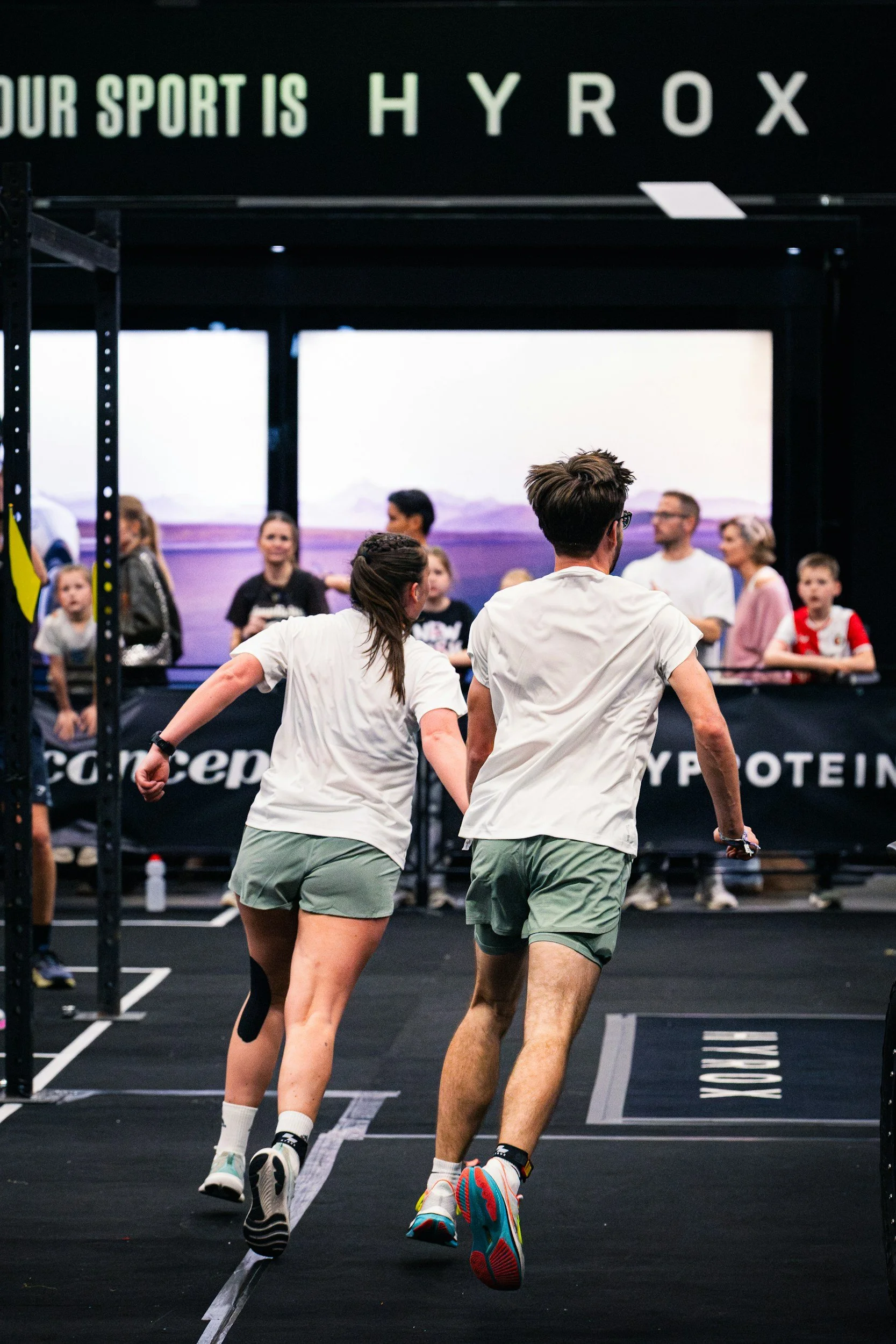
VO₂max testing for HYROX and hybrid athletes
HYROX places a unique demand on the cardiovascular system because athletes need to run repeatedly while also managing fatigue from sled work, lunges, carries, wall balls, and other stations.
For HYROX athletes, VO₂max testing can help answer important training questions:
Are your easy runs actually easy enough to build aerobic capacity?
Are your intervals being done at the right intensity?
Are you spending too much time in the grey zone?
Is your cardiovascular fitness limiting your race performance?
Do your heart rate zones match the demands of your current training?
Hybrid athletes often train hard across multiple qualities at once. That can work well, but it can also make training harder to interpret. VO₂max testing gives you a clearer baseline so your conditioning work is not based only on effort, pace, or guesswork.
Beyond just VO₂max testing, we offer a variety of other services for runnings including biomechanical running gait analysis, injury management and rehabilitation, and functional movement analysis with associated strength program planning.
Why Test With Dr. Steven Murray?
VO₂max testing is most useful when the results are interpreted properly.
My background combines clinical practice, exercise physiology, and performance testing. As a chiropractor with a Master’s degree in exercise physiology and CSEP High Performance Specialist certification, I look at VO₂max testing through both a clinical and performance lens.
That means the discussion is not limited to “your number is high” or “your number is low.” The goal is to understand what the result means for your training, your injury history, your current capacity, and your next step.
For runners and hybrid athletes, this can be especially useful because performance is rarely explained by one variable. Aerobic fitness matters, but so do strength, load management, running mechanics, recovery, and consistency.
Frequently Asked Questions
Still have questions? Take a look at the FAQ or reach out anytime. If you’re feeling ready, go ahead and book an appointment.
-
No. VO₂max testing can be useful for competitive athletes, recreational runners, HYROX athletes, and active adults who want a more objective understanding of their cardiovascular fitness.
The result is not just about ranking yourself against other people. It is about creating a clearer baseline and making better training decisions.
-
VO₂max testing measures how effectively your body uses oxygen during progressively harder exercise. It helps assess cardiovascular fitness and can guide training zones.
-
A watch estimate can be useful for tracking trends, but it is still an estimate. A direct VO₂max test measures your physiological response during exercise and allows the data to be interpreted in context.
The best use of testing is not simply confirming whether your watch is right or wrong. It is understanding what the result means for your training.
-
The test becomes progressively harder over time. The exact protocol depends on the purpose of the test and your current fitness level.
You should expect to work hard, but the test is controlled and structured. The goal is to collect useful information, not to turn the appointment into a random suffer-fest.
-
No. Testing gives you a baseline. That baseline can be useful whether you are already training seriously or just starting to become more structured.
If you are currently dealing with symptoms, medical concerns, or uncertainty about whether maximal exercise is appropriate, that should be discussed before testing.
-
For most people, retesting every 8 to 16 weeks makes sense if they are following a focused training block. Retesting too frequently is usually unnecessary because meaningful adaptation takes time.
-
Yes. One of the most practical uses of VO₂max testing is creating more individualized training zones. This can help you better separate easy training, moderate work, threshold work, and higher-intensity sessions.
-
VO2max testing is conducted at Thrive Longevity training with is a partner clinic of Back in Balance Clinic. The address is 518 Yonge St, Toronto, ON M4Y 1X9.