
If you are trying to lose body fat, gain muscle, or improve your body composition this summer, you will eventually run into the same question:
How many calories should I actually be eating?
Most people start with an online calculator. You enter your age, height, weight, and activity level, and it gives you a calorie target. That is not a bad starting point. But it is still an estimate based on population averages, and you may not be average.
A resting metabolic rate test gives you a more individualized baseline. It measures how much energy your body is using at rest rather than predicting it from a formula.
That does not mean the test gives you a perfect calorie prescription. Your resting metabolism is only one part of your daily energy expenditure. But if your body-composition goal matters to you, measuring your starting point is usually better than guessing.
What Is a Resting Metabolic Rate Test?
Your resting metabolic rate, or RMR, is the amount of energy your body uses to maintain its basic functions while you are resting. This includes breathing, circulation, brain activity, temperature regulation, and the work performed by your organs.
RMR is closely related to basal metabolic rate, or BMR. The terms are often used interchangeably outside of research settings. Strictly speaking, BMR is measured under more tightly controlled laboratory conditions. In a clinic, the practical measurement is usually RMR.
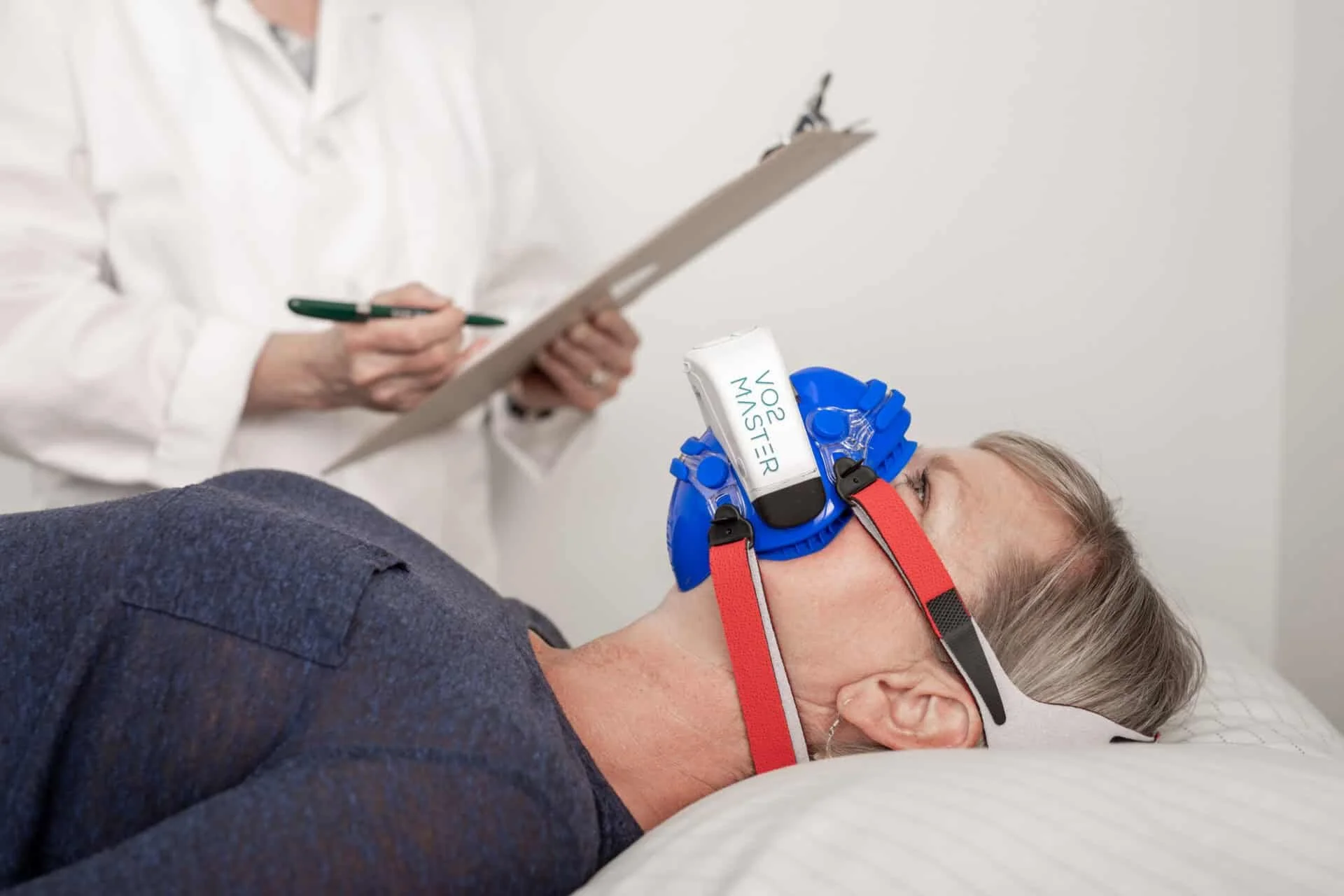
A resting metabolic rate test is performed using indirect calorimetry. While you rest comfortably, the device analyzes the amount of oxygen you are consuming. That information is used to calculate how many calories your body burns at rest over a 24-hour period.
The measurement is straightforward, but the preparation matters. Eating, caffeine, alcohol, nicotine, recent exercise, and even rushing into the clinic immediately before the test can affect the result. A proper test should be completed under standardized conditions.
Why Is an RMR Test Better Than a Calculator?
Online calculators are useful because they are simple and free. Some equations, particularly the Mifflin-St Jeor equation, perform reasonably well across groups of people.
The limitation is that you are not a group average.
Two people can be the same age, height, weight, and sex but have meaningfully different resting energy requirements. Differences in body composition, genetics, dieting history, training volume, and other physiological factors can all influence the result.
This does not make calculators useless. It means they should be treated as estimates.
For example, imagine that a calorie calculator estimates that your resting metabolic rate is 1,700 calories per day. Your measured RMR might be fairly close to that number. But it could also be lower or higher by a few hundred calories: an amount that matters when you are trying to create a moderate calorie deficit or a controlled surplus.
If your plan is only off by a small amount, you may still make progress. But you may spend several weeks making unnecessary adjustments before you find the right target.
A resting metabolic rate test can reduce that initial uncertainty.
Your RMR Is Not the Same as Your Daily Calorie Needs
This is where discussions about metabolism often become oversimplified.
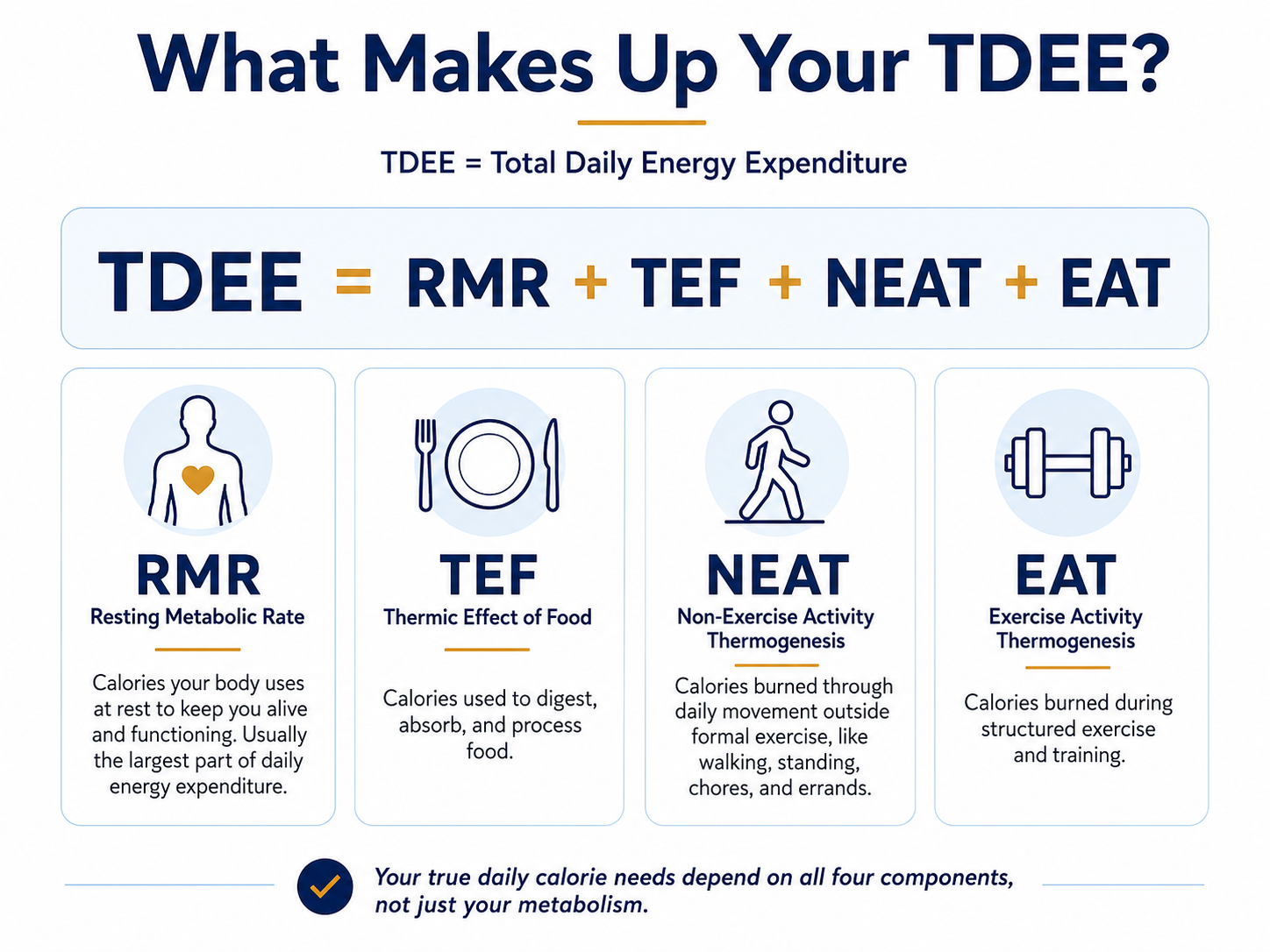
Your resting metabolic rate is usually the largest component of your daily energy expenditure, but it is not the only component.
Your total daily energy expenditure can be understood as the combination of four major factors:
Basal Metabolic Rate: BMR
This is the energy your body uses at rest. It provides the baseline.
Thermic Effect of Food: TEF
Digestion requires energy. The thermic effect of food is the energy cost of digesting, absorbing, and processing what you eat.
TEF varies depending on your overall calorie intake and the composition of your diet. Protein generally requires more energy to process than carbohydrate or fat. This is one reason that nutrition plans should not focus exclusively on calorie totals.
Non-Exercise Activity Thermogenesis: NEAT
NEAT includes the movement you accumulate outside of structured exercise: walking to work, taking the stairs, standing, completing errands, doing chores, and moving around throughout the day.
NEAT is easy to underestimate. It can also change when you diet. Some people unconsciously move less when their calorie intake drops, which may reduce their daily energy expenditure without an obvious change in their workout routine.
For someone working long hours at a desk in downtown Toronto, the difference between walking regularly and remaining seated for most of the day can be meaningful.
Exercise Activity Thermogenesis: EAT
EAT is the energy used during deliberate exercise, such as strength training, running, cycling, or group fitness classes.
Exercise is important for health and body composition, but the number of calories burned during a workout is frequently overestimated. Your watch, treadmill, or exercise bike may provide a useful reference point, but it should not be treated as a precise measurement of your calorie needs.
How Does RMR Testing Help With Fat Loss?

Fat loss requires a sustained calorie deficit over time. That principle is well established.
The goal is not usually to create the largest possible deficit. The goal is to create a deficit that is effective, sustainable, and compatible with maintaining muscle mass, training quality, and normal daily function. For most people, this is around a 500 calorie deficit per day. Some people can handle more, those that are more sensitive may need something slightly less.
A measured RMR gives you a more defensible baseline. From there, your activity level, training schedule, step count, nutrition habits, and rate of progress can be considered when setting an initial calorie target.
You still need to monitor the result. A well-designed plan should be adjusted based on trends in body composition, weight, gym performance, energy levels, hunger, and adherence.
There is another reason to avoid aggressive dieting. Energy expenditure can decrease during weight loss. Some of this is expected because a smaller body requires less energy. There may also be a variable degree of metabolic adaptation beyond what would be expected from the change in body size alone.
This is a real physiological response, but it is often exaggerated online. It does not mean that fat loss becomes impossible. It means that calorie targets may need to be reassessed as your body changes.
Does RMR Testing Help With Muscle Gain?

It can.
Muscle gain generally requires progressive resistance training, adequate protein intake (1.6-2.2g/kg body weight is ideal), sufficient recovery, and enough energy to support the process. For many people, that means eating in a modest calorie surplus.
The key word is modest.
A large surplus does not guarantee faster muscle growth. It may simply increase the amount of body fat gained alongside muscle. On the other hand, consistently under-eating can limit training quality and make it harder to gain lean mass.
A resting metabolic rate test can help establish a more informed starting point, particularly if you are training regularly but unsure whether you are eating enough to support your goals.
What an RMR Test Cannot Tell You
A resting metabolic rate test is useful, but it is not magic.
It does not measure your exact total daily energy expenditure. It does not automatically account for every workout, every walk, or every change in your schedule. It does not replace a well-designed training plan, consistent nutrition habits, or appropriate guidance from a registered dietitian when your situation is more complex.
It is best understood as a measured baseline.
That baseline can then be combined with your body-composition data, activity patterns, training goals, and progress over time to make better decisions.
Should You Get a Resting Metabolic Rate Test?
You do not need metabolic testing before making any change to your nutrition. A calculator and a consistent plan may be enough for someone who wants a general starting point.
Testing becomes more useful when you want greater specificity.
It may be worth considering if you have a clear body-composition goal, train regularly, have struggled to determine an appropriate calorie target, or want to reduce the amount of trial and error involved.
A good plan still requires follow-through. But it helps to start with your physiology rather than an average.
Frequently Asked Questions
Is a resting metabolic rate test the same as a BMR test?
The terms are often used interchangeably. In most clinic settings, the test measures resting metabolic rate rather than true basal metabolic rate because RMR can be measured under practical standardized conditions.
Does an RMR test tell me exactly how many calories to eat?
No. It measures how many calories your body uses at rest. Your daily calorie needs also depend on digestion, daily movement, and exercise. Your result should be used as a baseline and refined based on your goals and progress.
Is an RMR test useful for both fat loss and muscle gain?
Yes. For fat loss, it can help establish a more informed starting point for a calorie deficit. For muscle gain, it can help you avoid unintentionally under-eating or using an unnecessarily large surplus.
Are online calorie calculators inaccurate?
Not necessarily. They can provide reasonable estimates, particularly as an initial reference point. The limitation is that they predict your metabolism from population averages rather than measuring it directly.
Where can I get an RMR test in Toronto?
Resting metabolic rate testing is available at our downtown Toronto clinic as part of our performance-testing services.